Kway teow | 粿条
Silky, flat rice noodles served in a fragrant broth or stir-fried with meat and vegetables. A bowl of beef kway teow soup is a perfect introduction to Chaoshan's love of delicate textures and fresh flavors.
 Illustrated field notes / China · Chaoshan
An illustrated family adventure through Chaozhou, Shantou & Jieyang.
“What's for breakfast?” Antee asks, stepping off the train with a map in one hand and an empty stomach.
It's a very good question in Chaoshan (潮汕), the region of eastern Guangdong that includes Chaozhou (潮州), Shantou (汕头), and Jieyang (揭阳). Here, travelers can start the day with silky rice noodles, spend the afternoon beneath astonishing porcelain-covered roofs, and finish with a bubbling pot of beef hotpot or seafood congee.
But Chaoshan is much more than a food destination. Its residents have preserved distinctive Teochew language and traditions, while generations of travelers and overseas Chinese families have brought fresh ideas home. To see how it all fits together, we're following our favorite little explorer, Antee, through three cities and eleven unforgettable tastes.
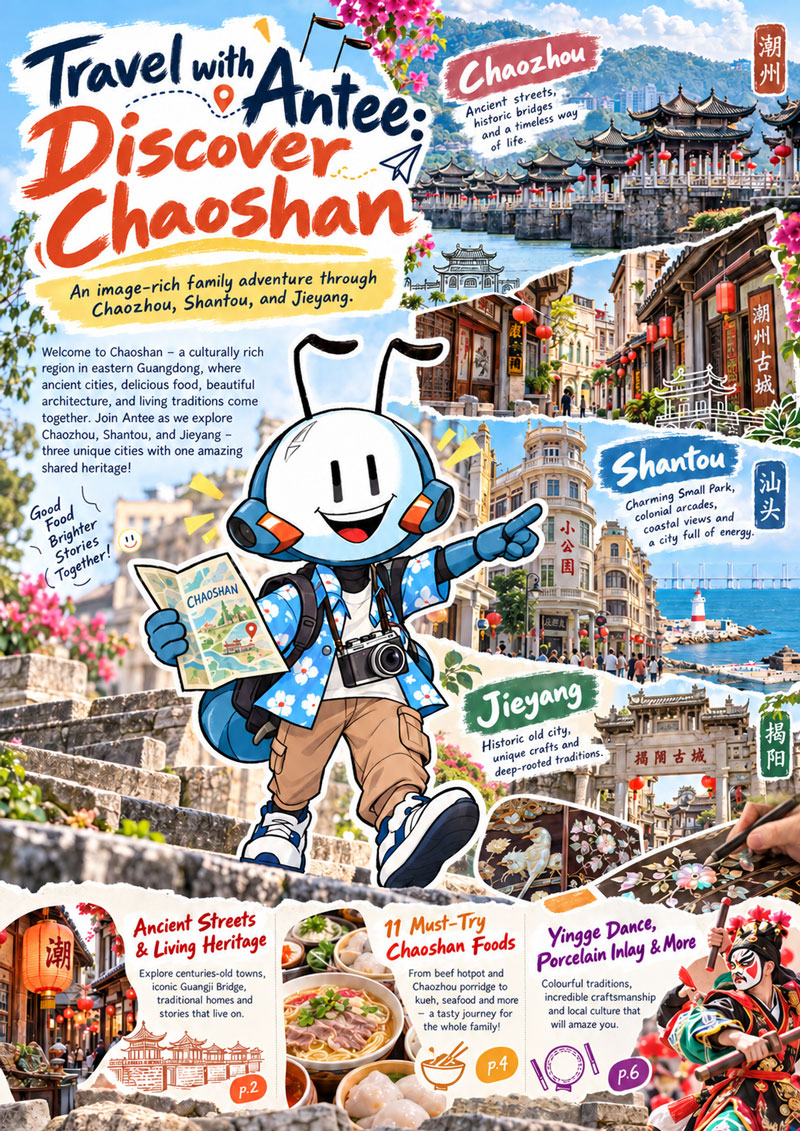
"In Chaoshan, food isn’t a side quest. It’s the adventure itself."
Silky noodles, fast-cooked beef, aromatic goose, extraordinary sweets: Chaoshan has a way of making every meal a discovery.
In Chaoshan, food isn't a side quest. It's the adventure itself. These dishes appear across the region, although individual shops and cities have their own styles. Look for their Chinese names on menus.
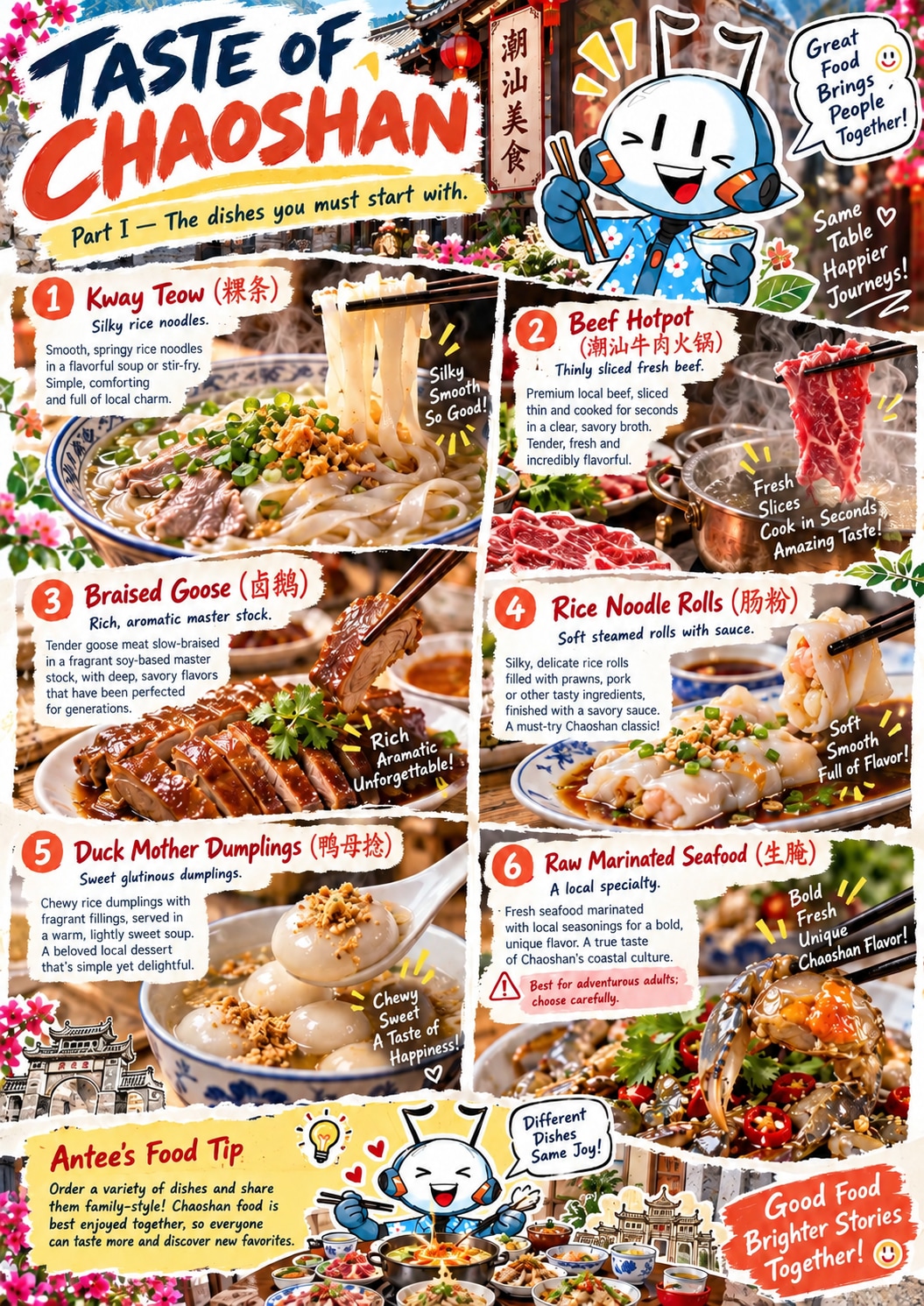
Silky, flat rice noodles served in a fragrant broth or stir-fried with meat and vegetables. A bowl of beef kway teow soup is a perfect introduction to Chaoshan's love of delicate textures and fresh flavors.
Fresh beef is sliced into different cuts and briefly cooked at the table in a relatively light broth. Try several cuts to compare their textures; the restaurant can advise how long each needs. Don't forget the bouncy beef balls and dipping sauces.
Tender goose, often including different cuts and offal, is simmered in a fragrant master stock flavored with spices. A plate of sliced goose offers a taste of one of Chaozhou's defining savory traditions.
Soft sheets of steamed rice batter wrap fillings such as pork, beef, shrimp, vegetables, or egg. Chaoshan versions vary from shop to shop, and local sauces can make the dish quite different from the versions found elsewhere in Guangdong.
Despite the playful name, this is not a duck dish! These tender glutinous-rice dumplings usually come in a sweet soup, sometimes with fillings such as sesame or bean paste. They're a lovely dessert after an old-town walk.
Crab, shrimp, or shellfish may be served raw after marinating in seasonings such as soy sauce, garlic, chili, and aromatics. This is a celebrated local specialty, but marinating does not make raw seafood safe. It carries foodborne-illness risks even at reputable establishments. For children, pregnant travelers, and anyone at increased risk of severe illness, choose fully cooked seafood instead.
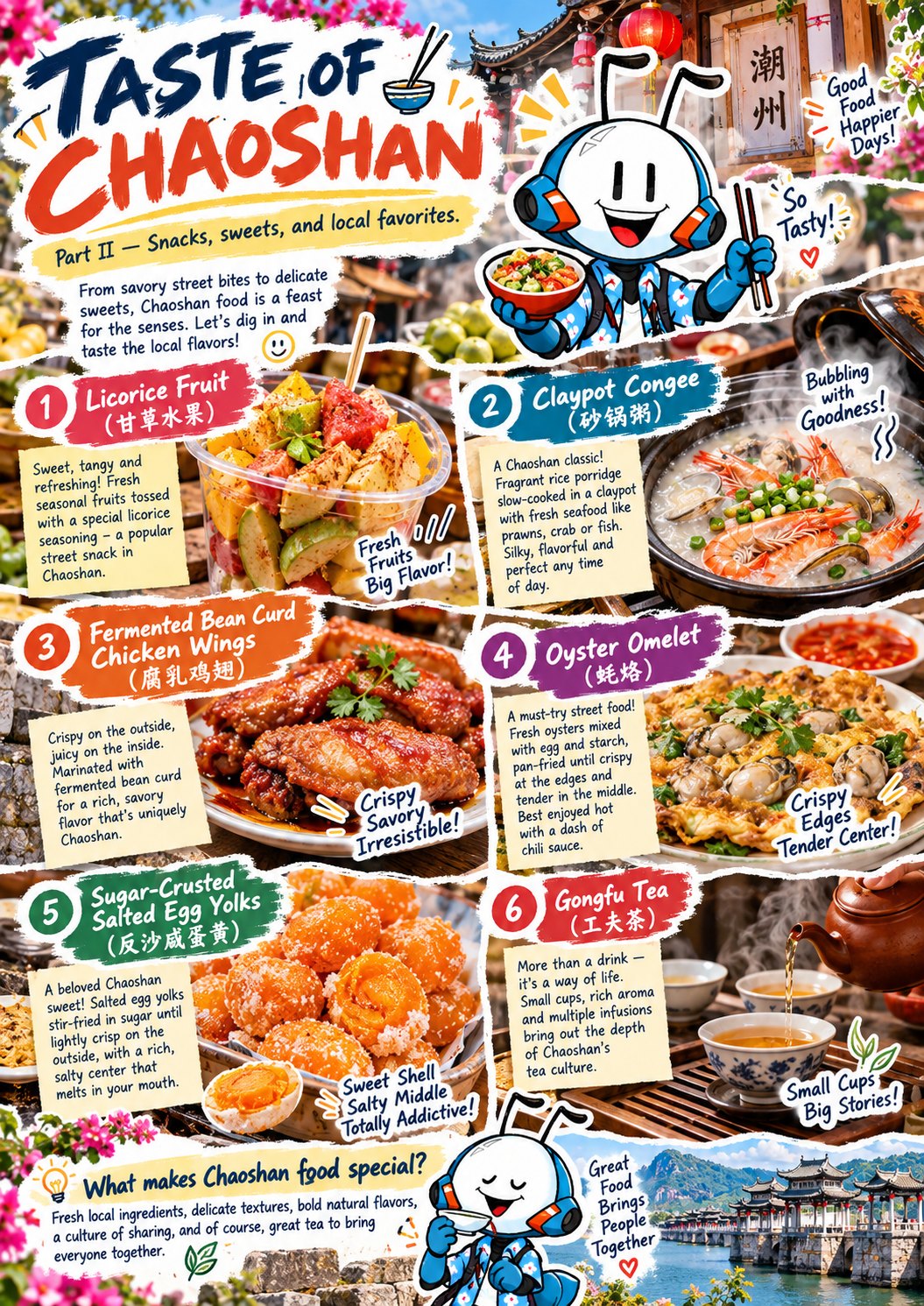
Fresh fruit becomes an addictive street snack with sweet, salty, and tangy seasonings, often incorporating licorice and preserved-plum flavors. Share a cup of mango, guava, pineapple, or seasonal fruit for a refreshing break between meals.
A bubbling claypot of rice congee, often prepared with shrimp, crab, fish, or other seafood. It is especially comforting at night. Order one for the table, and let the rice soak up the savory seafood flavors. (The standard Chinese name is 砂锅粥, rather than 烧锅粥.)
Chicken wings marinated with fermented bean curd are often fried until crisp and aromatic. The seasoning brings a rich, savory tang that makes these wings especially memorable.
Small oysters are cooked with egg and starch until the edges turn deliciously crisp while the center stays tender. It's a great dish to share, with layers of seafood sweetness and crunch.
This surprising sweet-savory snack features cooked, often fried salted egg yolks coated in sugar syrup that crystallizes into a delicate white crust. Take a bite and discover the contrast between a sweet shell and rich, salty center.
One more tradition, beyond the eleven: Make time for gongfu tea (工夫茶). Watching it brewed and shared is as revealing as visiting a monument: in Chaoshan, hospitality often begins with a tiny cup.
Try keeping a mini food passport: draw a noodle for something silky, a star for something crispy, a heart for something you want to eat again, and a question mark for the most surprising flavor. How many of the eleven can your family discover?
Loading Antee’s 11-food passport…
The best stories in Chaoshan are not all written down. Some are made from porcelain. Others arrive to the sound of drums.
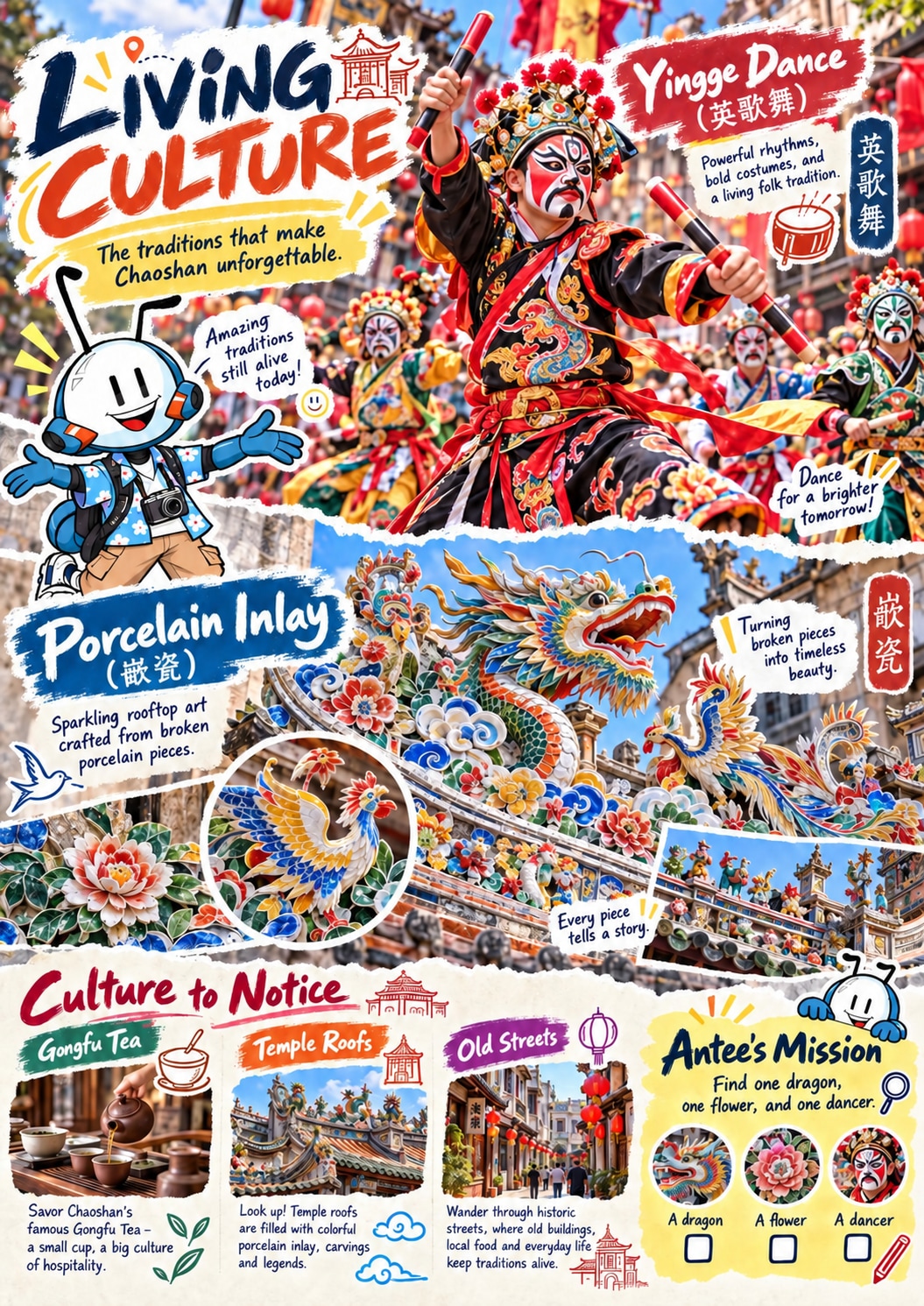
Antee notices something sparkling on an ornate roof: colorful dragons, birds, flowers, and figures that almost seem to leap into the sky.
This is Chaozhou porcelain inlay, known as qianci (嵌瓷). Craftspeople carefully cut colored porcelain into pieces and assemble them into vivid designs. The art is especially associated with traditional temples, ancestral halls, and historic buildings in the Chaoshan region. Unlike paintings that lie flat on a surface, many inlay designs rise from the roof in lively, sculptural forms.
Antee's culture mission: Find a roof decoration with an animal, a flower, and a person. Which pieces look three-dimensional? Sketch your favorite design, but leave the historic artwork untouched.
Best photo moment: Frame a Chaozhou archway against the blue sky, then zoom in on roof decorations and carved details. For a wide view, photograph Guangji Bridge from the riverside.
First foods to try: Start with kway teow (粿条), followed by braised goose (卤鹅). Save room for duck mother dumplings (鸭母捻) and a paper bag of crispy fermented bean curd chicken wings (腐乳鸡翅).
Suddenly, Antee hears drums. A group of performers with dramatic face paint steps forward, striking short wooden sticks together in powerful rhythms.
Yingge dance combines dance, martial-arts-inspired movements, and theatrical storytelling. Two particularly celebrated traditions are Puning Yingge (普宁英歌), associated with Puning in the Jieyang area, and Chaoyang Yingge (潮阳英歌), associated with Shantou's Chaoyang District. The formations, costumes, beats, and energetic movements are unforgettable.
Yingge is a living tradition rather than a performance available on demand. Public appearances often accompany festivals and community celebrations, so check a current local event schedule if seeing a live troupe is a priority. A cultural experience center in Puning may offer additional ways to learn about the tradition; confirm arrangements before traveling.
Antee's culture mission: Watch how the performers move together. Can you recognize a repeating rhythm or formation? Back at the hotel, design a colorful paper mask inspired by the performance.
Best photo moment: Jinxian Gate in warm late-afternoon light. For Yingge, use a fast shutter speed and photograph from a respectful distance without blocking the performers' route.
From Chaozhou’s floating bridge to Shantou’s overseas-Chinese mansions and the historic lanes of Jieyang.
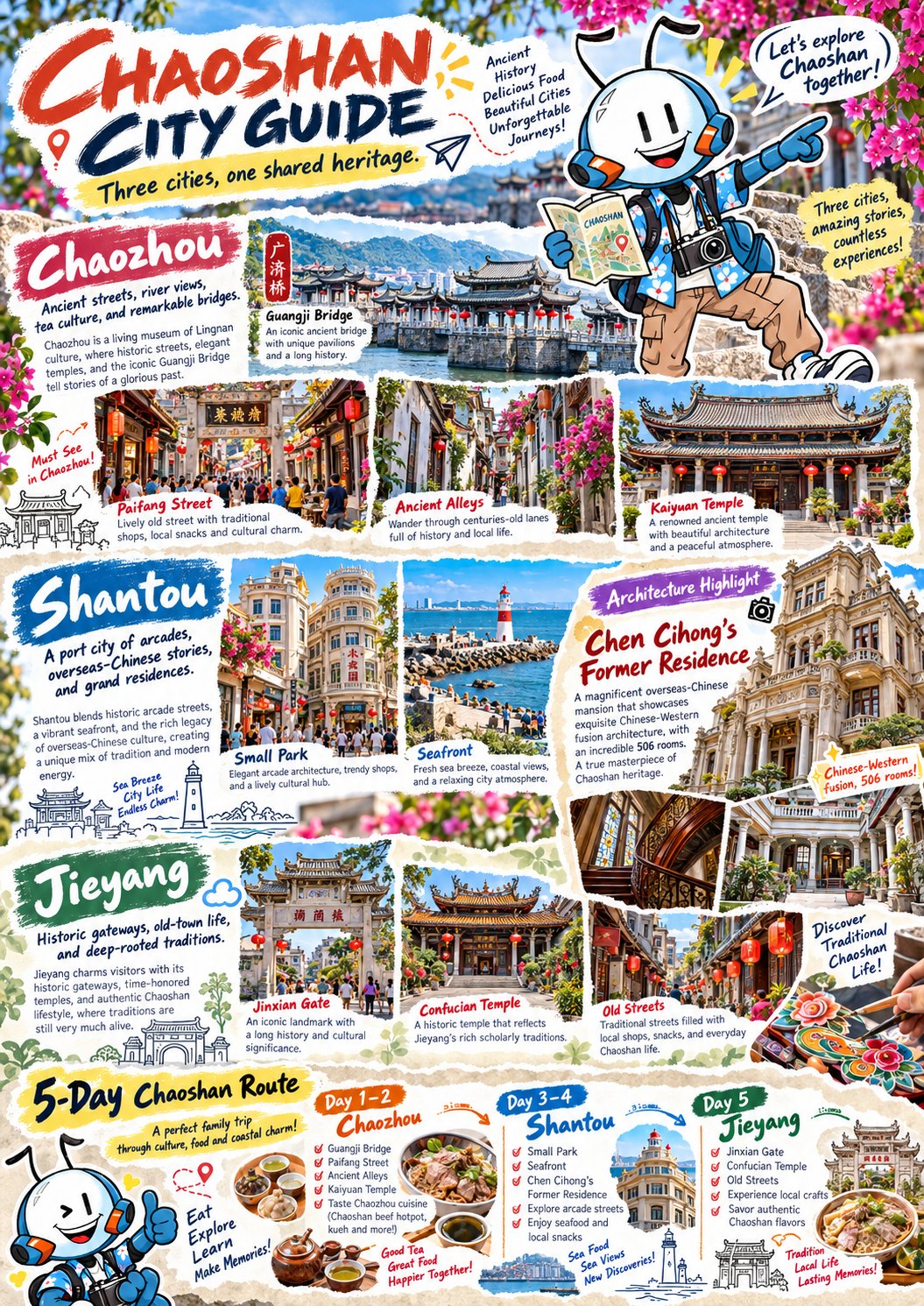
Antee begins in Chaozhou Ancient City, where the memorial gateways of Paifang Street (牌坊街) rise above busy shops and snack counters. Near the street stands Kaiyuan Temple (开元寺), founded in the Tang dynasty. A walk toward the Han River leads to Guangji Bridge (广济桥), famous for its central floating section made of boats that can be moved apart to let river traffic through.
The ancient city is a wonderful place to explore slowly. Take a morning walk when the light is gentle; stop at a tea shop to see how gongfu tea (工夫茶) is brewed in small pots and poured into tiny cups; then let the smell of nearby kitchens choose your next stop.
Next, Antee travels to Shantou, a historic port city with deep connections to overseas Chinese communities. In the old Small Park (小公园) district, handsome arcaded buildings recall an era of bustling trade. Here, even a walk between snacks turns into a lesson in architecture.
One of the region's most memorable architectural treasures lies in Qianmei Village (前美村), Chenghai District, outside central Shantou.
Chen Cihong's Former Residence is a huge family compound celebrated for its fusion of traditional Chaoshan residential design and Western architectural influences. The historic complex is commonly described as containing 506 halls and rooms. Its courtyards, balconies, patterned tiles, wooden and stone carvings, and winding passages make it feel like a small village hidden inside a mansion.
For families, the most compelling question is not simply how large the house is, but why it looks the way it does. Members of the Chen family had business connections overseas. The architectural details help tell a story of migration, homecoming, and ideas crossing borders.
Antee's architecture challenge: Spot one Chinese-style feature and one Western-style feature. What happens when a family brings the two together in the same building?
Best photo moment: Look for repeating doorways, patterned floor tiles, and sunlight entering a courtyard. Set aside roughly two hours or more, depending on which rooms are open.
Back in central Shantou, explore Small Park and learn about qiaopi (侨批), the letters and remittances that people living overseas sent home to their families. The story connects naturally with the Chen family's remarkable house.
Shantou is a fantastic place to make food the main event. Try steamed rice noodle rolls (肠粉) for breakfast, gather around Chaoshan beef hotpot (潮汕牛肉火锅) for dinner, then look for oyster omelet (蚝烙) and warming claypot congee (砂锅粥) in the evening. If you're spending an extra day nearby, Nan'ao Island (南澳岛) adds sea views, fishing-village scenery, and beautiful coastal photo opportunities.
Antee's third city is Jieyang. Begin at Jinxian Gate (进贤门), then visit the Jieyang Confucian Temple (揭阳学宫) to discover how learning and scholarship shaped traditional communities. The nearby streets invite unhurried walks and plenty of little snack stops.
| Day | Where to explore | Don't miss | Food mission |
|---|---|---|---|
| 1 | Chaozhou Ancient City | Paifang Street, Kaiyuan Temple, roof decorations | Kway teow, braised goose, fermented bean curd chicken wings |
| 2 | Chaozhou | Guangji Bridge, alleys, tea and craft discoveries | Duck mother dumplings, licorice fruit, sugar-crusted salted egg yolks |
| 3 | Shantou & Chenghai | Chen Cihong's Former Residence, Small Park | Rice noodle rolls, beef hotpot |
| 4 | Shantou | Food markets and old streets; optionally choose Nan'ao Island for a full-day coastal trip | Oyster omelet, claypot congee; raw-marinated seafood only for informed adults accepting the risks |
| 5 | Jieyang | Jinxian Gate, Jieyang Confucian Temple and old-town stroll | Revisit your favorite snack and try a different local variation |
Have a sixth day? Add a visit to Puning if a Yingge performance or cultural activity is confirmed. Trying to squeeze Puning, central Jieyang, and a flight into one day can make the trip feel rushed.